Early Buddhism was centered around the Ganges Valley.
Buddhism was founded by Siddhartha Gautama in the late 6th century BC. Accordimg to legend, Siddhartha Gautama was the son of a king and queen, who was born in Lumbini in what is know today as Nepal who was provided with many luxuries growing up. It was only when he once went on a series of four chariot rides he encountered true human suffering, these being; illness, old age, and death, and came to his own realization that all luxuries only masked suffering. He left he wife and son to try to take on severe renunciation in the forest until the point of near-starvation. Finally, realizing that this too was only adding more suffering, he ate food and sat down beneath a tree to meditate. the next morning it is said he had attained Nirvana, or Enlightenment, which gave both the true answers to the reasons of suffering and release from it. The Buddha began to spread his teachings. The most important doctrines he taught were the Four Noble Truths and Eight Fold Path.
After the death of the Buddha, Buddhism was further spread by the monks some of the his teachings. There was also engagment in practices like visiting the Buddha's birthplace and worshiping the tree under which he became enlightened. The famous king Ashoka and his son helped expand Buddhism throughout South India and into Sri Lanka and Burma around 3rd century BC.
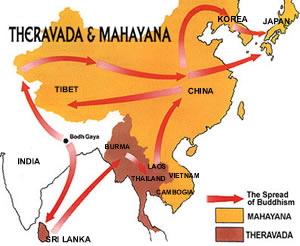
When the Mahayana school of Buddhism was spreading north along the Silk Road to China, Korea, Japan and Tibet, the Theravada school lost ground in the earlier times because the main financial support was for the expeditions of the Mahayana.
Buddhism first went to Bengal and then Sri Lanka from India early in the third Century BC. Sri Lanka became strongly Buddhist and followed the Theravada model. It was here that many of the early teachings were finally recorded.
From Sri Lanka, monks went to Burma in the 5th Century but it was not until the 12th Century AD that Buddhism became widely adapted. Thailand took on Buddhism in the 13th Century AD, with Laos and Cambodia followed, all following the Theravada school. At the same time, by the 15th Century, Buddhism had virtually disappeared from India.
History
The rise of the Sunga dynasty lead to the persecution of the Buddhist faith, and the deaths of many Buddhist adherents.
